Mongolia
Mongolia is not the kind of place you will understand before you go. It only really makes sense once you’re there standing in the middle of nowhere, where the horizon feels like it never ends and the sky somehow feels closer than anywhere else I’ve ever been. This guide is written from experience, from the road, from the wind, from the silence of the steppe. If you’re thinking about going, here’s what it’s really like and what you need to know.
Location
Mongolia is a vast country in Northern Asia, covering over 1.5 million square kilometers. On a map it may not look enormous, but that is because it lies between two giants: Russia to the north and China to the south.
In the north, it borders the forests and cold regions of Siberia. In the south, it shares a long 4,630 km border with China, stretching from the Altai Mountains in the west across the vast Gobi Desert to the remote eastern steppe.
What makes Mongolia feel so large is not just its size, but its emptiness endless horizons, open land, and distances that seem to go on forever.
Weather in Mongolia
Mongolia has a strong continental climate, which means the weather can be extreme and very different from season to season. It’s also a place where conditions can change quickly, so being prepared really makes a difference.
Summer
June – August is the most pleasant time to visit. Days are warm, often between 20–30°C, and the landscape is green and alive. Nights in the countryside can still feel quite cool, so a light jacket is useful.
Autumn
September – October is calm, crisp, and incredibly beautiful. The air becomes fresh, the skies are often clear, and the steppe turns golden. Temperatures drop, especially in the evenings, but the atmosphere is peaceful and perfect for travel.
Winter
November – March is very cold, with temperatures often falling below -20°C. Snow covers much of the country, creating a quiet, almost untouched landscape. It’s a challenging season, but also one of the most striking and unique.
Spring
April – May is windy and a bit unpredictable. The land slowly begins to wake up after winter, with shifting weather and a mix of sun, wind, and colder days.
Landscapes
Mongolia is a land of vast and changing landscapes, where every region feels like a different world. In the north, along the border with Siberia, dense coniferous forests stretch across the land, forming part of the southern edge of the great Taiga the largest forest region on Earth. Here you also find wide rivers and deep lakes, including Lake Khuvsgul, the largest in Mongolia. Its clear waters, covering about 2,760 square kilometers, are surrounded by mountains and reflect the sky in a way that feels almost unreal.
In the northeast lies the Khan Khentii range, a remote and largely untouched area of mountains and forest. It is a place filled with silence and mystery, known in history as the birthplace of Genghis Khan and believed by some to hold his secret resting place.
Moving south, the landscape slowly opens into the vast Gobi Desert. This is not only sand, but a wide mix of dunes, rocky cliffs, and dry plains shaped by wind over thousands of years. It is a place of strong contrasts harsh, quiet, and deeply beautiful.
To the west, the land rises into the Altai Mountains along the border with Russia and China. These mountains are rugged and powerful, with snow-covered peaks and deep valleys. The highest point in Mongolia is Tavan Bogd Peak at 4,374 meters, standing at the far western edge of the country.
From northern forests to southern deserts, from eastern mountains to western peaks, Mongolia is a country defined by space and variety. Each region feels different, yet all share the same sense of openness, silence, and untouched nature.
Mongolian population
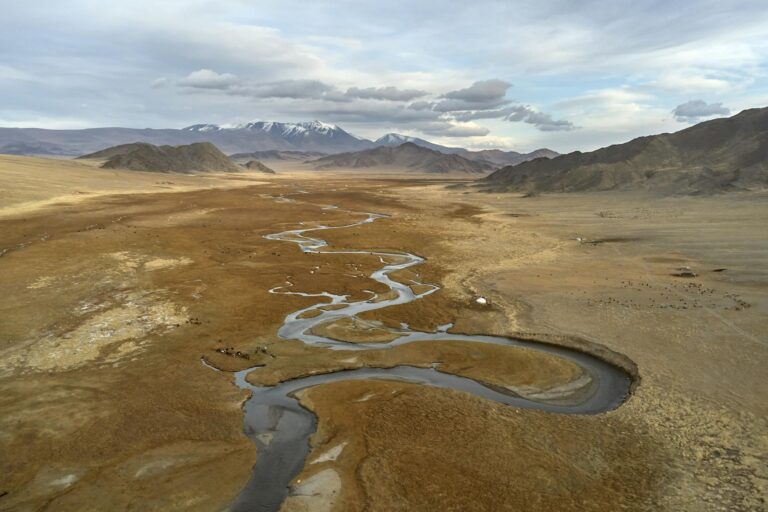
Mongolia is one of the most sparsely populated countries in the world, with a population of just over 3 million people spread across a huge land area of more than 1.5 million square kilometers. This creates an incredible sense of space long distances between towns, empty roads, and vast landscapes where you can travel for hours without seeing another settlement.
Most of the population is concentrated in the capital city, Ulaanbaatar, where nearly half of the country’s people live. Outside the city, life becomes much more spread out and closely connected to nature. Small towns are rare, and many people still live a traditional nomadic lifestyle, moving with their herds across the steppe depending on the season.
Because of this, Mongolia feels less like a densely settled country and more like an open land shared between people and nature. The low population density is one of the reasons the landscapes feel so untouched, so quiet, and so vast.
Mongolian culture
Mongolian culture is shaped by its nomadic way of life and deep connection to nature. Many people still live in traditional gers and move across the steppe with their animals.
Hospitality is very important, and guests are always welcomed with food and milk tea. The country’s history, especially Genghis Khan, is a strong part of national identity.
Traditions like horse riding, archery, throat singing, and the Naadam Festival continue to play a central role in everyday culture.